
How to Choose an Asparagus Optical Sorter?

Choosing an Asparagus Optical Sorter is not simply a matter of selecting the newest camera system. It is a decision about product quality, labor stability, yield, and long-term operating costs. Fresh asparagus moves quickly across belts, often carrying soil, broken tips, uneven thickness, or pale sections. A suitable sorter must recognize these differences without damaging tender spears.

Ian Roberts, Chief Technology Officer at Bühler Group, has said, “Data should guide better decisions, not replace practical experience.” This principle fits asparagus processing closely. A machine may offer high-resolution cameras, artificial intelligence, and automatic rejection. Yet performance can change with lighting, belt speed, moisture, and cultivar. Real factory conditions matter.

Look closely at the details. Can the Asparagus Optical Sorter identify purple discoloration near the tip? Can it separate fibrous pieces from acceptable spears? How much usable product enters the reject stream? These questions deserve measured trials, not impressive brochures. Ask suppliers to test your asparagus samples under different speeds and defect levels. Request data on accuracy, false rejects, compressed air use, cleaning time, and operator training.

No sorter performs perfectly.

That is the uncomfortable part. A system can reduce manual inspection, but it cannot eliminate every judgment. Poor calibration may waste premium asparagus. An excellent machine can still disappoint when maintenance is neglected. This guide examines the practical criteria behind sorter selection, helping processors compare technology with clearer expectations and fewer costly assumptions.
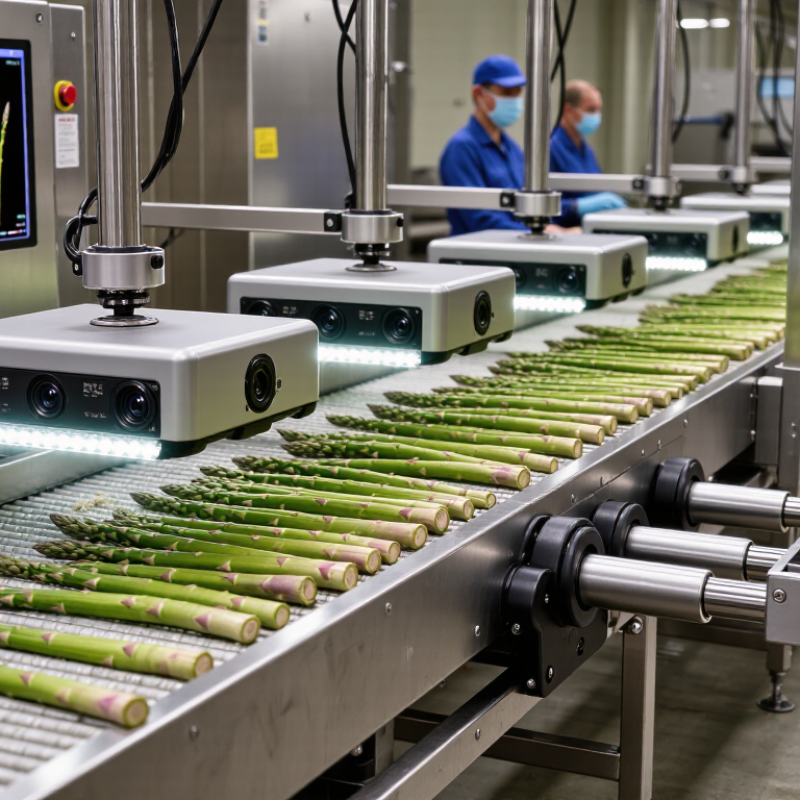
How to Choose an Asparagus Optical Sorter?

Define Sorting Goals and Asparagus Quality Criteria

Choosing an asparagus optical sorter starts with a clear definition of the sorting goal. Define the target.

Decide whether the line should remove white tips, fibrous stalks, bruised areas, soil marks, or mixed colors. Premium fresh asparagus may require strict color and straightness standards. Processing asparagus may accept minor surface marks but reject excessive thickness variation. Record acceptable limits in measurable terms, such as diameter range, defect size, and allowed discoloration. Quality criteria should match the final customer, not only the machine’s detection menu.

Use representative samples from different fields, harvest times, and storage conditions. A clean sample can mislead. Test pale spears, wet surfaces, broken tips, and overlapping products. Measure detection accuracy, false rejects, throughput, and product damage. A practical trial should compare the sorter’s decisions with trained manual inspection. Keep images and results for traceability. The system should also support stable lighting, simple sanitation, and regular calibration. Clean equipment matters.

No setting is perfect. A sorter may detect dark bruising well but miss shallow fiber damage. Excessive sensitivity can reduce yield. Weak sensitivity can lower customer satisfaction. Review rejected asparagus by hand during trials. This step often reveals whether the quality standard is realistic or poorly defined. Choose equipment that can be adjusted as varieties, seasons, and market requirements change.

Compare Optical Technologies for Color, Shape, and Defect Detection

Choosing an asparagus optical sorter starts with the defects your packing line actually sees. Color cameras can identify pale spears, purple tones, yellowing, and surface bruises under controlled lighting. They are fast and relatively easy to maintain. However, wet surfaces can create glare and confuse the inspection.

Shape matters. A 3D camera measures spear diameter, curvature, length, and broken tips. This helps separate bent or misshapen asparagus from acceptable produce. Shape data also supports size grading, but conveyor vibration may reduce measurement accuracy. Regular calibration is essential, especially when product height changes.

For hidden bruising, decay, or subtle internal differences, multispectral or near-infrared technology can reveal information beyond visible color. These systems may improve defect detection, but they usually require more careful setup and trained operators. In practical trials, combining RGB imaging with 3D or spectral sensing often produces a stronger result than relying on one camera type.

Do not overlook lighting. A sorter with excellent software can still fail under uneven illumination, dust, or changing moisture. Ask for test results using your own asparagus, including thin spears, damaged tips, and mixed cultivars. Review false rejects as carefully as missed defects. A cleaner image is not always a better decision.

Some lines need speed more than maximum sensitivity. Others need gentle handling and precise shape grading. The best configuration depends on crop variation, defect cost, labor availability, and cleaning routines. Expect a few disappointing test runs; they often expose assumptions that product brochures do not.

How to Choose an Asparagus Optical Sorter? - Compare Optical Technologies for Color, Shape, and Defect Detection

Optical Technology Color Detection Shape and Size Detection Defect Detection Typical Detection Detail Main Advantages Main Limitations Best Application
RGB Area-Scan Camera Excellent for green, purple, and white asparagus classification, tip discoloration, browning, and visible color variation. Good for length, diameter, curvature, broken tips, bent spears, and missing or irregular tips when products are well separated. Detects visible bruises, mold, soil, cuts, insect damage, surface scarring, and severe tip damage. Visible-spectrum imaging; performance depends strongly on camera resolution, lens selection, product spacing, and controlled illumination. Cost-effective; versatile; suitable for simultaneous color, appearance, and dimensional inspection. Limited ability to identify defects hidden beneath the surface or defects with little visible color contrast. General-purpose grading and sorting of fresh asparagus with clearly visible external defects.
RGB Line-Scan Camera Very good for continuous color inspection at high conveyor speeds, including longitudinal discoloration and uneven pigmentation. Very good for length, diameter, straightness, taper, and tip geometry when the conveyor provides stable product presentation. Detects continuous surface defects such as scars, cuts, dark spots, mold, soil, and damaged tips across the full product length. Builds an image line by line and is suited to high-speed conveyors with consistent motion. High inspection coverage; efficient use of pixels; strong choice for continuous, high-throughput lines. Requires accurate synchronization, stable belt speed, and careful lighting alignment; more sensitive to product overlap. Large-volume packing lines where throughput and full-length surface inspection are priorities.
Near-Infrared (NIR) Camera Fair for broad material or moisture-related differences, but not a replacement for RGB when precise green, purple, or white color grading is required. Similar geometric capability to a conventional camera when combined with suitable optics and image-processing software. Can improve detection of some moisture differences, bruising, contamination, or low-contrast material changes that are difficult to see in RGB. Uses reflected near-infrared light; penetration is limited and results vary with variety, moisture, surface condition, and calibration. Adds material-contrast information beyond visible color; useful as a complementary inspection channel. Higher system cost than standard RGB; spectral response is affected by lighting, calibration, and product variability. Applications where moisture-related or material-related defects are important and RGB inspection is insufficient.
Multispectral Camera Very good for separating products or defects with subtle spectral differences that may appear similar in standard RGB images. Good for shape and size when paired with a visible-spectrum channel or a dedicated geometric camera. Improves identification of selected bruises, decay indicators, foreign material, and surface conditions with distinctive spectral signatures. Captures several discrete wavelength bands rather than a complete spectrum; actual results require product-specific calibration. More targeted and faster to process than full hyperspectral imaging while providing additional information beyond RGB. Not every defect has a unique spectral signature; setup and algorithm development are more complex than RGB systems. Specialized sorting programs requiring improved material discrimination without full hyperspectral complexity.
Hyperspectral Imaging Excellent for detailed spectral classification, but conventional RGB is usually more economical for routine visual color grading. Shape measurement is possible, but a separate RGB or monochrome channel is often more efficient for geometry and dimensional grading. Strong potential for subtle bruising, decay, moisture variation, chemical differences, and defects that are visually similar to healthy tissue. Records many narrow wavelength bands and normally requires reference samples, calibration, and statistical or machine-learning models. Provides the richest spectral information and supports advanced defect research and classification. High equipment and integration cost; larger data volume; generally more demanding maintenance and model validation. Research, premium quality control, and difficult defect categories that cannot be reliably separated with RGB or NIR.
3D Laser or Structured-Light Vision Limited for color classification unless combined with an RGB camera. Excellent for diameter, height profile, curvature, tip position, shape irregularity, and dimensional consistency. Detects dents, deep cuts, missing sections, deformation, and raised or recessed surface abnormalities; weak for purely color-based defects. Measures surface geometry rather than spectral appearance; performance depends on product stability and surface reflectivity. Best dimensional accuracy among the listed options; useful for shape-based grading and alignment. Cannot independently classify most color, discoloration, mold, or material-composition defects. Lines where diameter uniformity, curvature, tip geometry, or three-dimensional deformation is critical.
Selection Guide: Choose RGB when visible color and external defects are the main criteria; choose RGB line-scan for high-speed continuous inspection; add NIR or multispectral imaging for difficult material or moisture-related defects; consider hyperspectral imaging for advanced quality research; and use 3D vision when dimensional accuracy and shape control are more important than color.
Note: Actual sorting accuracy depends on asparagus variety, diameter range, product overlap, conveyor speed, camera resolution, lighting, calibration samples, and the quality of the classification algorithm. Validate performance with representative seasonal samples before final equipment selection.

Evaluate Capacity, Accuracy, and Product Handling Requirements

How to Choose an Asparagus Optical Sorter?

Evaluate Capacity, Accuracy, and Product Handling Requirements

Choosing an asparagus optical sorter starts with your real production flow. Measure peak hourly volume, not the average from a quiet morning. A sorter must handle sudden field deliveries without creating a crowded feed line. Check whether its stated capacity matches your asparagus size range, moisture level, and trimming condition. Capacity figures can look impressive on paper. They may change during busy harvest periods.

Accuracy also needs practical testing. Ask for trials using your own asparagus, including pale spears, bent pieces, soil marks, and broken tips. Inspect false rejects beside acceptable product. A high rejection rate can reduce saleable yield, even when detection appears excellent. Confirm how the system records defects and whether operators can review performance data. Calibration should be simple enough for daily use. I have seen accurate systems lose consistency when lenses became dusty or lighting changed.

Tips: Watch the product handling path closely. Gentle belts, controlled drops, and suitable spacing help protect tender tips. Examine the reject mechanism during a full-speed test. It should remove defects without striking nearby spears. Ask operators to clean and adjust the machine themselves. Their feedback often reveals problems that brochures miss. Leave room for improvement. Your first settings may not suit every harvest lot. Check results regularly and refine them with measured data.

Review Machine Configuration, Software, and Integration Options

Choosing an asparagus optical sorter starts with its physical configuration. Inspect the infeed belt, camera position, lighting enclosure, and reject system. Fresh asparagus often varies in diameter, length, color, and tip shape. The machine must handle these differences without bruising delicate spears. Ask for test results using your own harvest samples, not only laboratory produce. Check belt speed, throughput, cleaning access, and food-contact materials. A practical trial reveals problems that brochures often hide.

Software controls sorting accuracy. Look for adjustable size, color, curvature, and defect thresholds. The interface should show live images and rejected-product reasons clearly. Operators need quick recipe changes between fields, seasons, and customer specifications. Automatic calibration can reduce setup time, but it should not replace human inspection. I once trusted an attractive default setting and noticed too many acceptable spears leaving the line. That mistake changed my view of “smart” software. Record false rejects, missed defects, and performance under changing light.

Integration determines whether the sorter improves the whole operation. Confirm compatibility with conveyors, weighing equipment, packing stations, data systems, and emergency controls. Shared signals should remain stable during belt stops and product surges. Ask whether the machine provides production counts, defect data, alarms, and remote diagnostics in usable formats. A small buffer before the sorter can prevent uneven feeding. It may also require extra floor space. Review maintenance training, spare-part access, and network security with the supplier’s technical team. A short on-site acceptance test is worth the effort.

Assess Maintenance Needs, Total Cost, and Supplier Support

Choosing an asparagus optical sorter requires more than comparing camera resolution. Start with maintenance. Asparagus fields bring soil, moisture, plant fibers, and uneven spears into the line. Ask how often lenses need cleaning, how quickly belts can be replaced, and whether calibration requires a specialist. A five-minute inspection routine is valuable. A perfect machine that operators avoid is not.

Total cost should include compressed air, electricity, software, training, spare parts, integration, and rejected-product losses. The U.S. Department of Energy’s Operations and Maintenance Best Practices Guide reports that predictive maintenance can reduce maintenance costs by 25–30% and downtime by 35–45%. These figures cover general industrial systems, not asparagus sorters, so treat them as benchmarks rather than promises. Build a three-year model using your actual throughput, labor rate, and seasonal operating hours. Small assumptions can distort the result.

Supplier support often decides whether performance survives the harvest season. Request documented response times, local technician coverage, remote diagnostics, and guaranteed spare-part availability. Confirm who trains night-shift operators. PMMI’s 2024 industry research continues to identify workforce capability and automation support as major processing concerns. That matters during a wet week, when one blocked air nozzle can quietly reduce accuracy. I would also test difficult samples, not only clean laboratory spears. Some evaluation methods are imperfect. Record every failure, including the embarrassing ones, and make the supplier explain the repair path.

How to Choose an Asparagus Optical Sorter?

Assess maintenance needs, total cost, and supplier support before selecting equipment. The chart presents a five-year planning benchmark for a mid-sized asparagus packing operation.

Estimated values are shown in USD and should be replaced with supplier quotations, site-specific energy rates, labor costs, and service agreements during procurement.

We will help turn your vision into reality

Contact Us