
Choosing a Wpc Exterior Panel is not simply a matter of matching colors to a building. It involves moisture, sunlight, temperature changes, installation methods, and long-term maintenance. A panel that looks impressive in a showroom may warp, fade, or stain when exposed to rain and intense sunlight. Small details matter. Check the surface texture. Inspect the locking edges. Ask for technical data, not only attractive photographs.
Dr. Christian Clemons, a wood-plastic composite researcher at the USDA Forest Products Laboratory, stated, “Wood-plastic composites are made from wood and thermoplastics.” This simple explanation carries practical meaning. The wood content affects texture and moisture response. The plastic component influences durability and water resistance. Additives, manufacturing quality, and installation conditions also shape performance. Therefore, buyers should compare composition, density, fire performance, warranty terms, and testing standards before choosing a Wpc Exterior Panel.
Real projects also teach uncomfortable lessons. Dark panels can become very hot beside south-facing walls. Poor ventilation may trap moisture behind the cladding. Even a premium product can fail when installers ignore expansion gaps. That is not always the panel’s fault. It is not always the installer’s fault either. The decision needs honest evaluation. The following seven tips examine appearance, material quality, climate suitability, structural performance, installation requirements, maintenance, and supplier reliability. These points cannot guarantee perfection, but they can reduce expensive surprises and support a more defensible exterior-panel choice.
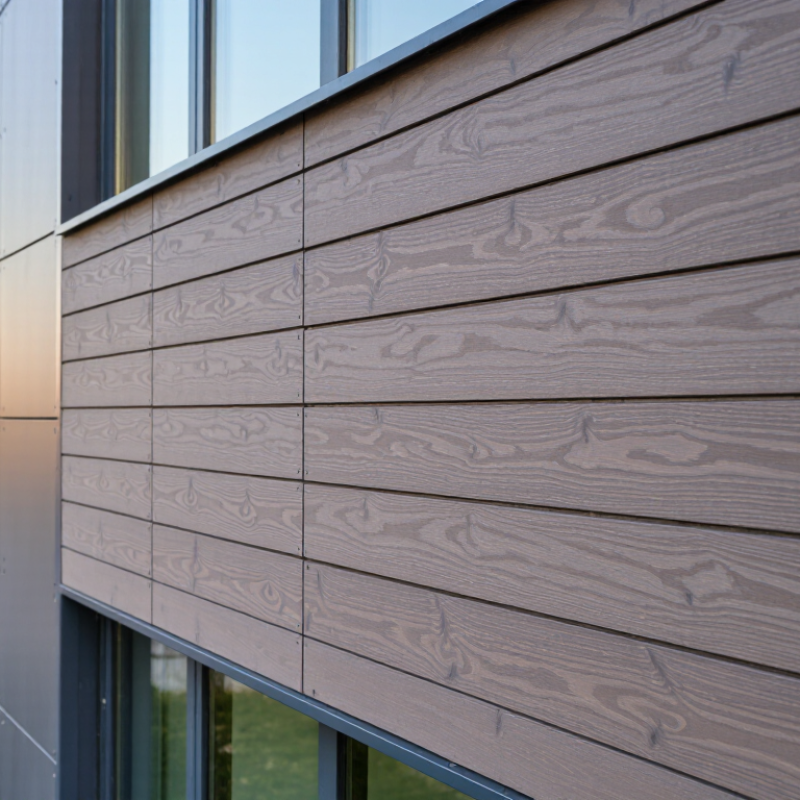
7 Tips for Choosing WPC Exterior Panels
Tip 1: Define your climate before comparing panels. Record seasonal temperature, rainfall, humidity, snow, and direct sunlight. Coastal projects need special attention to salt-laden air. Tip 2: Identify the real load conditions. Wind pressure, snow weight, panel span, and fastener spacing can change the required performance. A shaded wall and a rooftop screen do not face the same demands.
Tip 3: Read ASTM D7031 performance data carefully. This guide supports evaluation of mechanical and physical properties in wood-plastic composite products. Check reported values for flexural strength, stiffness, moisture absorption, and dimensional change. These figures help compare materials, but they do not replace project-specific engineering. Tip 4: Ask whether testing reflects actual panel thickness and profile. A hollow section may perform differently from a solid section. Small details matter. Tip 5: Review moisture behavior after repeated wetting and drying. A panel that looks stable in a showroom may move at exposed joints.
Tip 6: Match the data with installation conditions. Leave movement gaps, use compatible fasteners, and support long spans properly. Tip 7: Request test reports, sampling details, and clear laboratory methods. Reliable decisions need traceable evidence. I have seen specifications rely on one impressive number while ignoring temperature or edge restraint. That approach is tempting, but incomplete. Recheck every value against the wall location, expected service life, and maintenance access.
| Tip | Climate or Load Variable | Relevant Performance Data | Applicable Test Method or Code Reference | How to Use the Information |
|---|---|---|---|---|
| 1 | Moisture and rainfall exposure Frequent rain, splash zones, coastal humidity, or poor drainage | Water absorption, thickness swelling, dimensional change, and retention of flexural properties after moisture conditioning | ASTM D7031; water absorption is commonly evaluated with ASTM D570; dimensional change may be reported after conditioning | Request conditioned and unconditioned results. Prefer panels with documented drainage details, sealed cut edges where required, and low moisture-related movement. ASTM D7031 is a guide and does not establish one universal pass/fail value. |
| 2 | Solar radiation and UV exposure High-altitude, tropical, desert, or unobstructed south-facing elevations | Color change, surface chalking, cracking, loss of gloss, and change in flexural performance after accelerated weathering | ASTM D7031; accelerated exposure is commonly performed using ASTM G154 fluorescent UV lamps or ASTM G155 xenon-arc equipment | Compare the exposure cycle, irradiance, condensation or water-spray conditions, and evaluation period. Do not compare weathering results unless the test cycle and rating method are equivalent. |
| 3 | Temperature range and thermal movement Freeze-thaw climates, strong daily temperature swings, or dark-colored cladding | Coefficient of thermal expansion, dimensional stability, heat-deflection behavior, and performance after hot/cold conditioning | ASTM D7031; heat-deflection temperature may be measured with ASTM D648; thermal expansion may be measured with ASTM E831 or an equivalent documented method | Use the reported movement to size expansion gaps and attachment slots. Follow the panel manufacturer’s installation temperature limits; do not substitute heat-deflection temperature for a safe service temperature. |
| 4 | Wind pressure and suction Open terrain, high-rise locations, hurricane regions, or exposed corners | Flexural strength, flexural modulus, panel span capacity, fastener resistance, and connection performance | ASTM D7031; flexural properties may be determined using ASTM D6109 or ASTM D790; project wind loads are calculated under the applicable building code, such as ASCE/SEI 7 | Convert the project wind pressure into panel and fastener reactions. Check both positive pressure and suction, especially at corners, edges, parapets, and around openings. |
| 5 | Service and maintenance loads Walkable ledges, exterior screens, guards, soffits, or panels exposed to impact | Bending strength, stiffness, deflection, impact resistance, creep, and fastener pull-out or pull-through resistance | ASTM D7031; applicable structural design loads should be taken from the governing building code. For many U.S. residential deck applications, a 40 psf live-load value is commonly specified by the IRC, subject to jurisdiction and application. | Do not use a decking load value automatically for a façade panel. Define the actual load case, support spacing, span direction, allowable deflection, and safety factors for the specific installation. |
| 6 | Freeze-thaw and cyclic conditioning Regions with repeated freezing, thawing, and wetting cycles | Cracking, delamination, edge damage, dimensional change, and retained strength after conditioning cycles | ASTM D7031 can be used to organize conditioning and performance evaluation; the exact freeze-thaw procedure must be stated in the test report or project specification | Ask for the number of cycles, temperature limits, moisture condition, specimen orientation, and post-test inspection criteria. A generic “freeze-thaw tested” statement is not sufficient for comparison. |
| 7 | Panel layout and attachment system Long runs, tight joints, concealed clips, or mixed substrates | Panel thickness, support spacing, joint width, edge distance, screw or clip capacity, creep under sustained load, and installation tolerances | ASTM D7031 for performance evaluation; fastener and connection design must follow the applicable structural standard, product evaluation report, and local building code | Evaluate the complete assembly rather than the panel alone. Confirm substrate compatibility, corrosion resistance of fasteners, ventilation, drainage, movement joints, and maintenance access. |