
China Top 10 Galvanized Welded Pipe Manufacturers?

China’s Galvanized Welded Pipe sector is large, competitive, and increasingly quality-focused. The World Steel Association reported that China produced approximately 1.019 billion tonnes of crude steel in 2023. That scale supports a deep supply chain for welded pipe, zinc coating, testing, and export logistics. However, steel output alone does not prove product reliability.

The World Bank’s Commodity Markets Outlook shows that steel costs remain sensitive to energy prices, construction demand, and regional trade conditions. Meanwhile, ASTM A53, ASTM A795, EN 10255, and ISO 1461 provide useful reference points for pipe dimensions, coating, and performance. Buyers still need to check mill certificates, coating thickness, weld integrity, and hydrostatic test records. A bright surface can hide inconsistent protection.

Gregory Crawford, a corrosion-control specialist and former leader of the American Galvanizers Association, has described hot-dip galvanizing as “a proven, sustainable corrosion protection system.” His point matters here. Zinc protects exposed steel through a barrier layer and sacrificial action, especially around scratches and cut edges.

This guide evaluates China’s top 10 Galvanized Welded Pipe manufacturers through practical criteria: production capacity, coating consistency, standards compliance, export experience, inspection systems, and project references. It also considers less visible details, such as thread accuracy, bundle protection, packing quality, and response speed after delivery. Rankings are never perfect. Factory data can change, and public information may be incomplete. Therefore, independent verification remains essential before placing a large order.
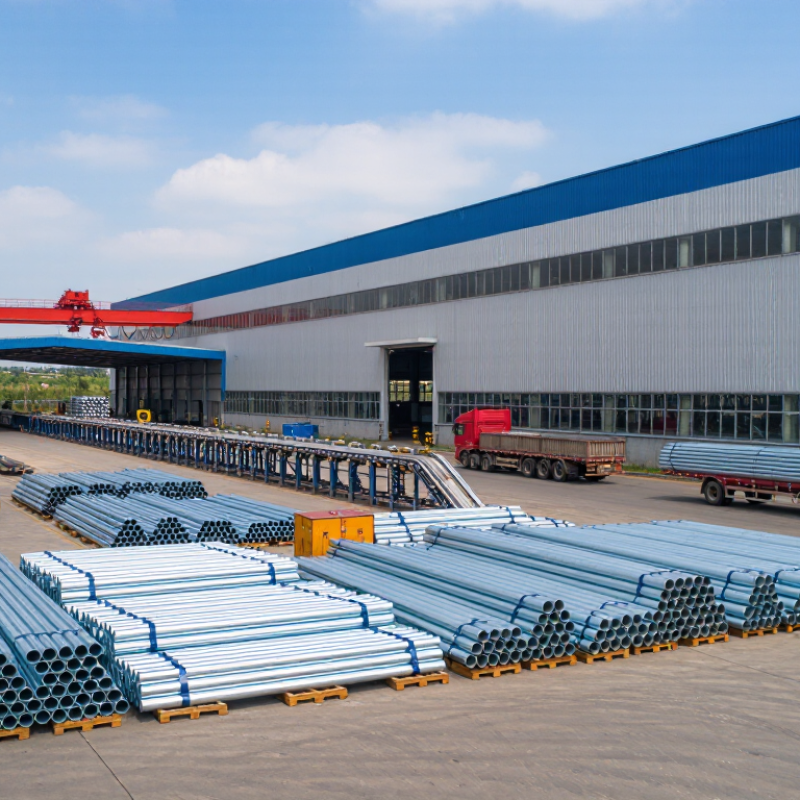
China Top 10 Galvanized Welded Pipe Manufacturers?

What Are Galvanized Welded Pipes and How Are They Made?

Galvanized welded pipes are steel tubes protected by a zinc coating. The zinc slows rust when moisture reaches the steel surface. They commonly carry water, air, and other low to moderate pressure fluids. Their welded seam runs along the pipe length.

Manufacturing starts with a flat steel strip, usually supplied in coils. Rollers gradually form the strip into a round shape. High-frequency electric resistance welding then joins the meeting edges. The weld is trimmed, and sizing rollers correct the diameter. Workers inspect the seam for visible defects and dimensional accuracy.

Before galvanizing, the pipe needs a clean surface. Manufacturers remove oil, scale, and rust through cleaning and pickling. Some processes use flux before dipping the pipe into molten zinc. The zinc bath is typically near 450°C, so temperature control matters. Cooling follows immediately, while excess zinc is removed from the surface. Another method uses electrogalvanizing, which creates a thinner coating for lighter service.

Good inspection includes coating-thickness measurement, visual checks, and pressure testing when required. Threaded ends may receive extra attention because cutting can expose bare steel. In practical use, coating thickness is not always perfectly uniform, especially near edges and welded areas. That detail is easy to overlook. Galvanized pipe can also perform poorly in highly corrosive chemicals or continuously wet conditions, where material selection deserves another review.

How to Evaluate China’s Galvanized Welded Pipe Manufacturers

How to Evaluate China’s Galvanized Welded Pipe Manufacturers

Evaluating a galvanized welded pipe manufacturer requires more than comparing prices. Check its production experience, technical staff, and export history. Ask how it controls steel chemistry, tube forming, welding, and galvanizing. A reliable factory should explain each step clearly. Vague answers deserve caution.

Request recent inspection reports and product samples. Measure outside diameter, wall thickness, length, and zinc coating. Inspect the weld seam for uneven marks, pinholes, or excessive grinding. Ask whether testing follows the required standard and whether an independent laboratory can verify results. Certificates matter, but traceable records matter more. Match heat numbers, batch documents, and packing lists carefully.

Visit the facility when possible. Observe coil storage, furnace temperature control, bath cleanliness, and finished-pipe protection. A strong manufacturer can show calibrated gauges, maintenance records, and corrective-action reports. Confirm production capacity against your delivery schedule, not just advertised output. Discuss thread protection, bundles, moisture control, and loading methods. These details often affect losses at the job site.

Communication is another practical test. Send a detailed drawing and review the response. Does the engineering team identify unclear tolerances? Does the sales team admit limitations? That honesty is valuable. No supplier is flawless. Even a careful audit may miss a process problem. Use trial orders, clear acceptance criteria, and staged inspections to reduce that risk. A lower quotation may hide thinner walls, weaker galvanizing, or poor packaging. Real evaluation takes evidence, not promises.

China’s Top 10 Galvanized Welded Pipe Manufacturers

China’s Top 10 Galvanized Welded Pipe Manufacturers are often compared by more than production volume. Experienced buyers inspect coating uniformity, weld strength, dimensional accuracy, and delivery consistency. A reliable factory should provide mill certificates, batch records, and inspection reports. These documents reveal more than a polished website.

The strongest manufacturers usually operate automated forming, welding, sizing, and hot-dip galvanizing lines. During a plant visit, buyers can check pipe surfaces under bright inspection lamps. A sound coating looks continuous, without bare spots, heavy drips, or trapped ash. Wall thickness should be measured at several points, not only near the pipe end. Testing may reference GB/T 3091, ASTM A53, or EN 10255, depending on the project.

Details matter. Threaded ends should remain clean and properly protected. Bundles need firm steel straps and weather-resistant wrapping. This reduces damage during long-distance transport. Production capacity can also be misleading. A large facility may still struggle with small custom orders or urgent replacement batches. That is easy to overlook.

The top ten should therefore be judged through samples, factory audits, response records, and repeat quality. One weakness remains common: catalog specifications may not match actual delivery. Independent inspection is sensible, especially for fire protection, water, and structural applications. Reliability is built shipment by shipment.

Key Products, Standards, and Production Capabilities

China’s top 10 galvanized welded pipe manufacturers are often judged by products, standards, and manufacturing discipline. Common products include round pipes, square tubes, rectangular tubes, scaffolding pipes, and greenhouse tubing. Many factories use electric resistance welding for consistent seams and efficient output. Some also provide hot-dip galvanized pipes, where zinc protects the steel from moisture and outdoor corrosion.

Reliable manufacturers usually work with standards such as GB/T 3091, ASTM A53, ASTM A500, and EN 10255. ISO 1461 may guide hot-dip galvanized coating requirements. Buyers should verify the exact edition and application range. Standard names alone prove little. A serious supplier can provide mill certificates, coating measurements, dimensional reports, and hydrostatic or eddy-current test records. Traceability should connect each bundle to its heat number and production date.

Production capability matters during large or repeated orders. Check available outside diameters, wall thicknesses, pipe lengths, zinc coating ranges, and monthly capacity. Modern lines may include automatic forming, online welding inspection, controlled galvanizing baths, threading, grooving, and bundling. Warehouses should protect pipes from standing water and white rust. That detail is easily missed. Factory audits remain useful, but even a well-prepared visit cannot reveal every weakness. Sample testing by an independent laboratory adds practical confidence.

How to Select the Right Chinese Manufacturer for Your Project

China Top 10 Galvanized Welded Pipe Manufacturers: How to Select the Right Chinese Manufacturer for Your Project

When comparing China’s top ten galvanized welded pipe manufacturers, begin with your project conditions. Confirm pipe diameter, wall thickness, length, zinc coating, and connection method. A supplier should explain its process clearly, from steel coil inspection to welding, galvanizing, threading, and final packing. Ask for recent mill certificates and test reports. Check whether testing follows the standards required in your market, such as GB, ASTM, or EN. Do not accept a generic certificate without batch traceability. Real production details matter.

Tips: Request samples from the same production line. Measure outside diameter, wall thickness, and coating thickness independently. Inspect weld continuity and cut several sections for visual review. A factory audit can reveal storage problems, poor labeling, or limited equipment. Also review monthly capacity, lead time, export experience, and packaging for sea transport. A low quotation may exclude testing, inland delivery, or protective caps. Clarify every cost in writing.

Communication is another practical test. Reliable manufacturers answer technical questions with drawings, tolerances, and corrective actions. They should offer a realistic inspection plan, not perfect promises. A polished website proves little. No checklist is perfect. Recheck critical dimensions before shipment, especially when pipes will enter crowded construction sites or automated assembly lines. Supplier selection should balance price, consistency, documentation, and after-sales responsibility.

China Top 10 Galvanized Welded Pipe Manufacturers? - How to Select the Right Chinese Manufacturer for Your Project

A non-branded evaluation framework for comparing qualified Chinese manufacturers

Rank Evaluation Dimension What a Qualified Manufacturer Should Provide Relevant Standard or Reference Best Fit for Evidence to Request
1 Product Standard Compliance Clear compliance with the required pipe specification, dimensions, steel grade, weld requirements, and test criteria. GB/T 3091 for welded steel pipes; ASTM A53/A53M for pressure and mechanical applications; ASTM A500/A500M for structural tubing. Water, gas, structural, fencing, and general engineering projects. Current mill test certificates, product datasheets, inspection plans, and sample reports.
2 Galvanizing Quality Consistent zinc coating, proper surface preparation, acceptable adhesion, and controlled coating thickness across the pipe surface. ISO 1461 for hot-dip galvanized coatings on fabricated iron and steel articles; ASTM A123/A123M for structural products. Outdoor infrastructure, agricultural systems, guardrails, and corrosion-exposed installations. Zinc-coating test results, visual inspection records, coating process details, and third-party inspection access.
3 Dimensional Capability Ability to produce the requested outside diameter, wall thickness, length, end finish, ovality, and straightness within specification limits. ASTM, EN, or GB dimensional tolerances specified in the purchase contract. Projects requiring reliable fit-up, threading, couplings, flanges, or automated installation. Dimensional inspection records, calibrated gauge certificates, and approved production samples.
4 Weld Integrity Stable longitudinal welding, controlled weld parameters, acceptable weld appearance, and testing appropriate to the application. The applicable ASTM, EN, or GB pipe standard; NDT requirements should be defined in the purchase specification. Pressure service, structural frames, scaffolding, and load-bearing applications. Welding procedure documentation, welder or operator qualifications where applicable, hydrostatic or NDT reports.
5 Raw Material Traceability Traceable links between incoming steel coils or strips, production batches, test results, and final bundles. Heat-number and batch-traceability practices required by the selected product standard and contract. Regulated projects, critical infrastructure, and projects requiring complete quality documentation. Heat certificates, coil records, batch numbers, production logs, and bundle labels.
6 Testing and Inspection Documented inspection procedures covering chemical composition, mechanical properties, dimensions, weld quality, and coating condition. Inspection and testing requirements stated in GB/T, ASTM, EN, or project-specific specifications. Buyers needing repeatable quality and independently verifiable shipment records. Laboratory scope, equipment calibration records, inspection and test plans, and independent inspection reports.
7 Production Capacity Sufficient forming, welding, galvanizing, testing, and packing capacity for the required monthly volume and delivery schedule. Capacity should be validated against the buyer’s size range, quantity, and delivery window rather than a general annual claim. Large construction programs, framework contracts, and recurring procurement. Production-line list, current capacity confirmation, lead-time history, and a factory or remote audit.
8 Export and Packaging Readiness Export-compatible marking, bundle protection, moisture control, loading plans, and documentation suitable for international shipment. Incoterms® rules for delivery responsibilities; project-specific packing and marking instructions. International buyers, container shipments, and long-distance ocean transport. Packing photos, loading diagrams, shipping documents, export references, and insurance arrangements.
9 Commercial Transparency A clear quotation showing steel grade, size, wall thickness, zinc coating, quantity, tolerances, testing, packaging, payment terms, and delivery basis. Purchase contract and Incoterms® rules should define price scope, risk transfer, and responsibilities. Projects where total landed cost and contract clarity are more important than the lowest unit price. Itemized quotation, contract draft, payment schedule, warranty terms, and written deviation list.
10 Quality Assurance and After-Sales Support A documented quality management system, responsive technical communication, corrective-action procedures, and support for claims or replacement. ISO 9001 certification may support quality-system evaluation, but it should not replace product testing or independent verification. Long-term supply agreements, engineered projects, and buyers with strict approval procedures. Quality manual, certification scope, complaint records, corrective-action examples, and customer reference checks.
Selection note: A manufacturer should be shortlisted only after its product standard, coating requirement, testing scope, production capacity, and commercial terms have been verified for the specific project.

We will help turn your vision into reality

Contact Us