
China Top Solar Light Tower Manufacturers and Suppliers?

China Top Solar Light Tower Manufacturers and Suppliers? This question deserves more than a factory list. Buyers need evidence about illumination, battery performance, charging speed, mobility, and after-sales support. A tower may look powerful under showroom lighting, yet struggle beside a muddy construction road after several cloudy days. That difference matters.

The International Renewable Energy Agency reported 473 gigawatts of renewable capacity additions in 2023. Solar power represented about 75% of that expansion, showing strong momentum across the global energy market. The International Energy Agency also identifies solar photovoltaics as a central driver of future electricity growth. As IEA Executive Director Fatih Birol stated, “Solar PV is the new king of electricity markets.” This broader trend supports interest in the Solar Light Tower sector, especially for construction sites, emergency work, mining areas, and remote infrastructure.

Still, the market has weaknesses. Public reports rarely separate solar light towers from wider temporary lighting equipment. Product claims can also be difficult to compare. Rated brightness may omit operating duration, temperature effects, or battery degradation. Careful buyers should request test records, warranty terms, lumen data, panel specifications, and real deployment references. Manufacturers in China vary considerably in engineering depth and quality control. Some provide strong customization. Others offer attractive prices but limited technical documentation. This guide examines leading Chinese manufacturers and suppliers through practical criteria, including product reliability, certifications, production experience, export capability, and service responsiveness. The ranking is not absolute. Site conditions change everything. A coastal project, for example, needs different protection from a dry inland warehouse.
China Top Solar Light Tower Manufacturers and Suppliers?

Solar Light Towers: Definition, Functions, and Main Applications

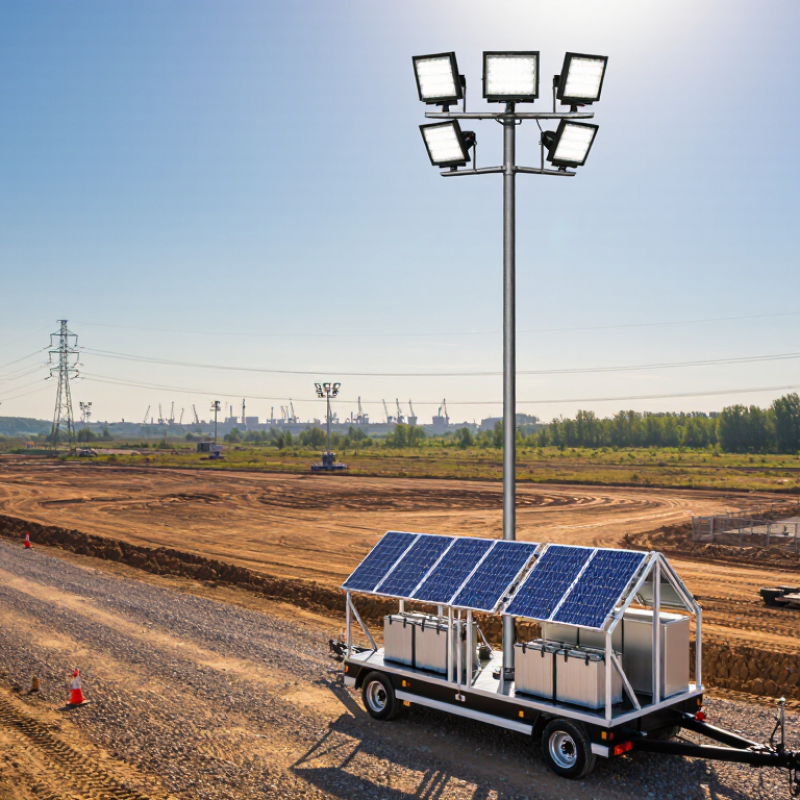
Solar light towers are mobile lighting systems powered by photovoltaic panels, batteries, and high-efficiency lamps. They provide illumination without a permanent electrical connection. During daylight, solar panels charge the battery. After sunset, stored energy powers the lamps for several hours. Many towers use adjustable masts, stabilizing legs, and automatic dusk sensors.

These towers support road repairs, construction zones, emergency response, agricultural work, and outdoor events. A four-lamp tower can spread light across a broad work area. It may also reduce fuel storage, engine noise, and routine maintenance. However, performance depends on sunlight, battery condition, dust, and temperature. A cloudy week can change the operating result. This detail is easy to underestimate.

Tips: Check the required lighting area before choosing a tower. Review panel size, battery capacity, mast height, and wind resistance. Place the unit where nearby buildings will not shade the panels. Clean dusty surfaces regularly, especially on construction sites. Do not rely on published runtime alone. Test the tower under realistic evening conditions. A model that works well in summer may need different positioning during winter. Operators should also inspect cables, locks, wheels, and emergency controls before each shift.

China’s Solar Light Tower Manufacturing Industry

China’s Solar Light Tower Manufacturing Industry is supported by a deep photovoltaic supply chain. IRENA’s Renewable Capacity Statistics 2024 reports that China added about 216.9 GW of solar capacity in 2023. Its cumulative solar capacity reached approximately 609.5 GW. This scale supports faster sourcing of panels, lithium batteries, LED lamps, controllers, and galvanized masts for mobile light towers.

The IEA’s Solar PV Global Supply Chains report notes that China holds more than 80% of global solar manufacturing capacity. That advantage can shorten procurement cycles and reduce component costs. In practical production, reliable suppliers test battery protection, charging performance, mast stability, and lighting duration. A tower used beside a road needs more than bright LEDs. It needs stable wheels, sealed connectors, and a controller that survives dust and rain.

Quality still varies.

Some factories present excellent laboratory data but provide limited field records. That gap deserves attention. Buyers should request IEC-related test evidence, battery cycle results, lighting curves, and inspection reports before selecting China-based manufacturers or suppliers. The IEA Renewables 2024 report also highlights continuing growth in solar deployment, yet light tower performance depends on local weather and operating habits. A cloudy construction site can expose weak battery sizing quickly. Manufacturers improving thermal management, remote monitoring, and recyclable battery designs may gain stronger trust in overseas markets.

China Solar Light Tower Manufacturing Industry: Solar Market Growth Context

China’s rapidly expanding solar installation base supports the development of solar lighting equipment, including mobile solar light towers used for construction, emergency response, infrastructure projects, and outdoor events. The figures show annual newly installed photovoltaic capacity in China, measured in gigawatts.

Source: China National Energy Administration (NEA), annual national renewable energy development statistics. The data represents the wider solar energy market rather than individual manufacturers or brands.

Leading Types of Solar Light Towers Made in China

China Top Solar Light Tower Manufacturers and Suppliers?

Leading Types of Solar Light Towers Made in China

Chinese manufacturers produce several practical solar light tower types for construction sites, road maintenance, emergency areas, and outdoor events. Mobile solar light towers usually combine foldable photovoltaic panels, LED lamps, batteries, and a trailer frame. Their wheels and adjustable masts support quick relocation. Some models use hydraulic lifting systems, while simpler units use manual poles. I have found that panel size and battery capacity strongly affect overnight performance.

Hybrid solar light towers add a backup generator for cloudy periods or demanding lighting schedules. All-in-one towers place the battery, controller, and lighting system inside one weather-resistant cabinet. High-mast versions provide wider coverage for large work areas. Compact telescopic towers suit narrow roads and temporary inspection points. The best type depends on required brightness, operating hours, terrain, and transport frequency. Bigger is not always better.

Tips: Ask suppliers for verified lighting data, battery cycle information, and protection ratings. Request a real load test, not only a product brochure. Check whether the mast remains stable during strong wind. Confirm charging performance in winter conditions. A common mistake is choosing by lamp wattage alone. That approach can hide weak batteries, limited panel output, or poor thermal design. Before ordering, inspect sample units and review maintenance access. Some specifications look impressive but need practical verification.

China Top Solar Light Tower Manufacturers and Suppliers? - Leading Types of Solar Light Towers Made in China

Solar Light Tower Type Typical Solar Array Typical Battery System LED Lighting Power Mast Height Typical Operating Time Common Applications Key Purchasing Considerations
Compact Portable Solar Light Tower 100–300 Wp photovoltaic panels 1–3 kWh lithium or LiFePO4 battery 50–150 W 3–6 m Approximately 8–20 hours per charge Small construction areas, pathways, events, emergency lighting Foldable frame, transport weight, battery protection, setup time
Trailer-Mounted Solar Light Tower 300–800 Wp photovoltaic panels 2–10 kWh lithium or LiFePO4 battery 100–400 W 5–9 m Approximately 8–24 hours per charge Roadwork, mining sites, large construction projects, outdoor security Trailer braking and stability, lifting mechanism, wind resistance, service access
Foldable-Panel Solar Light Tower 200–600 Wp foldable or hinged panels 2–6 kWh rechargeable battery 80–300 W 4–8 m Approximately 10–24 hours per charge Temporary work zones, disaster response, military and civil protection Panel durability, folding locks, cable protection, deployment footprint
High-Mast Solar Light Tower 400–1,000 Wp photovoltaic panels 4–12 kWh battery storage 200–600 W 6–12 m Approximately 8–18 hours per charge Ports, logistics yards, sports grounds, industrial compounds Foundation or ballast design, wind-load calculations, lighting distribution, maintenance height
Solar Light Tower with CCTV or Monitoring 200–600 Wp photovoltaic panels 2–8 kWh battery storage 60–250 W 4–9 m Approximately 8–24 hours, depending on camera load Perimeter security, remote sites, parking areas, utility projects Camera resolution, network connectivity, data storage, cybersecurity, night-vision performance
Solar-Diesel Hybrid Light Tower 300–800 Wp photovoltaic panels 2–10 kWh battery storage 100–400 W 5–9 m Solar operation supplemented by generator backup Remote construction, mining, infrastructure and long-duration projects Automatic changeover, fuel consumption, generator noise, emissions and maintenance requirements
Specification note: The figures shown are typical market ranges for comparison. Actual performance depends on solar irradiation, panel orientation, battery state of charge, ambient temperature, LED efficiency, operating schedule and site conditions. Common procurement requirements may include IP65 or higher enclosure protection, battery management protection, corrosion-resistant hardware, photovoltaic module documentation, and applicable electrical safety and electromagnetic compatibility testing.

How to Evaluate Chinese Solar Light Tower Suppliers

Evaluating Chinese Solar Light Tower Suppliers

A reliable supplier should explain every major component, not only quote a bright lighting figure. Request datasheets for the solar panel, battery chemistry, LED module, controller, and mast. Check whether the stated illumination was measured in a real field test. A product can appear strong on paper but perform poorly during several cloudy nights.

Ask for a sample unit before placing a larger order. Inspect welds, powder coating, cable glands, fasteners, and the mast locking system. Test automatic dusk-to-dawn operation and measure runtime after limited sunlight. An IP rating should match a verifiable test report, not just a catalog statement. For coastal or dusty sites, ask about corrosion resistance and enclosure protection.

Supplier experience becomes clearer through factory records and customer references. Review production capacity, quality-control procedures, spare-part availability, and warranty terms in writing. Independent reports for batteries, electrical safety, and photometric performance add useful confidence. Communication matters too; delayed technical answers may become costly after shipment.

Do not trust polished samples completely. Batch consistency deserves attention. I have seen attractive prototypes hide weaker connectors or different battery cells in later units. Ask for serial-number tracking, pre-shipment inspection, packaging photos, and clear remedies for failed tests. A dependable partner welcomes detailed questions, even uncomfortable ones.

Purchasing, Certification, and Quality Considerations in China

Buying solar light towers in China requires more than comparing prices. Start with the site’s actual working conditions. Record required illumination, operating hours, terrain, wind exposure, transport frequency, and charging limits. A tower for a warehouse differs from one used on remote roadwork.

Ask for a complete bill of materials. It should identify panels, batteries, lamps, controllers, cables, and mast sections. Do not guess.

Certification needs careful reading. Request current certificates and matching test reports, not brochure logos. Check model numbers, rated voltage, laboratory identity, issue dates, and testing scope.

CE may support European market access, but it does not replace every applicable requirement. For batteries, review transport test documents and safety data. For China sales, confirm whether CCC applies to the specific configuration.

ISO 9001 indicates process control, not automatic product quality. This distinction is often missed.

Quality checks should include a pre-shipment sample and independent inspection. Test light output after several cloudy charging cycles, not only on sunny afternoons. Measure battery runtime, mast locking strength, wheel stability, waterproofing, and emergency controls.

Ask for an IP test basis, spare-parts list, and warranty response times. Traceable serial numbers connect defects to production batches. A factory visit may reveal weak cable glands or rushed welding.

Yet one visit proves little. Even careful buyers can overestimate laboratory data. Keep acceptance criteria written, measurable, and linked to payment milestones. Records matter.

We will help turn your vision into reality

Contact Us